
The Great Salt Lake isn’t just a scenic backdrop to Utah’s Wasatch Front—it’s the lifeblood of our community’s health, economy, and very survival. Yet this vital resource is disappearing before our eyes, and with it, the foundation of a sustainable population and thriving communities across Northern Utah.
The science is unequivocal: preserving Great Salt Lake is not an environmental issue separate from human wellbeing—it is a public health imperative, an economic necessity, and a matter of environmental justice.
The Direct Threat to Public Health
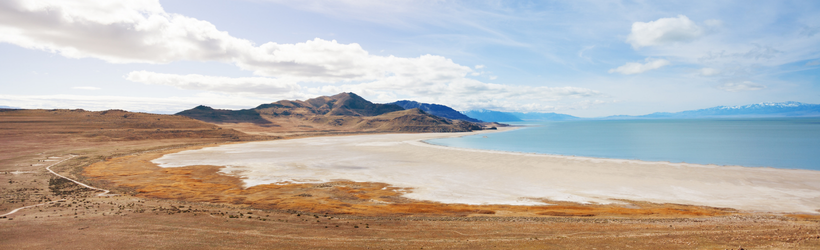
When Great Salt Lake shrinks to unusally low levels, it exposes thousands of acres of lakebed containing not just salt, but heavy metals like arsenic, mercury, and lead—legacy pollutants from decades of mining, agriculture, and industrial discharge. This toxic dust doesn’t stay put.
Dr. Courtney Henley, a physician and board member of Utah Physicians for a Healthy Environment, describes the scope of this threat: “The medical urgency arises from the pervasive nature of the threat. All living beings will inhale blowing lakebed dust, and every human resident in the path of blowing dust is impacted.”
The U.S. Geological Survey has confirmed that this isn’t hypothetical—it’s happening now. Recent USGS research shows that dust from the dry Great Salt Lake lakebed contributes to potential health risks, particularly for children in Northern Utah communities. Children are especially vulnerable due to their smaller body sizes and greater rates of dust ingestion, with exposure to heavy metals during early years potentially leading to developmental issues and long-term health problems.
The reality is stark: 2.5 million Utahns live downwind of the exposed lakebed. Every dust storm carries toxins into our lungs, our homes, and our children’s schools.
An Environmental Justice Crisis
The burden of the shrinking lake falls disproportionately on communities of color. Research published in the journal One Earth by University of Utah sociologist Sara Grineski and colleagues reveals a disturbing pattern: Pacific Islander and Hispanic residents living in northwestern parts of Salt Lake City suffer some of the worst dust pollution from the drying Great Salt Lake, and these communities also had the most to gain from restoring lake levels.
This disparity isn’t accidental—it’s the result of historical redlining that pushed many people of color into western, more industrialized neighborhoods. Now, as the lake dries, these same communities face the highest exposure to toxic dust.
But here’s the encouraging finding: Grineski’s research shows that raising lake levels would reduce dust exposure for everyone while narrowing the exposure gap between communities. As she notes, restoring the lake is “definitely a win-win.”
The Economic Cost of Inaction
The economic case for preserving Great Salt Lake is overwhelming. According to recent economic research by Dr. Albert Garcia at the University of Utah, Great Salt Lake dust is currently costing the local economy approximately $30 million annually. But that’s just the beginning. Over the next 20 years, negative health outcomes and premature deaths could set the Salt Lake area community back one billion dollars.
The broader economic impacts are even more staggering. Studies cited by scholars at the University of Utah’s Stegner Center project that economic losses from a declining lake could reach $25.4 billion to $32.6 billion over 20 years, with more than 6,500 jobs lost.
This isn’t abstract economic theory—it’s about real families, real livelihoods, and real communities. The lake directly supports over 7,700 jobs and contributes $1.9 billion annually to Utah’s economy through mineral extraction, brine shrimp harvesting, and recreation. But the ripple effects extend much further.
The Snow Connection: More Than Recreation
Great Salt Lake plays a surprising but crucial role in Utah’s famous powder snow. The lake contributes 5-10% to Utah’s snowpack and extends the ski season by 5 to 7 weeks. This isn’t just about recreation—Utah’s ski industry includes 20,000 jobs and contributes $1.2 billion each year to the state’s economy.
But there’s a more fundamental concern: as dust from the exposed lakebed settles on mountain snowpack, it causes snow to melt earlier, threatening the water supplies that our entire region depends on. A healthy lake means healthy snowpack, which means sustainable water resources for our growing population.
Learning from the Fate of Other Lakes
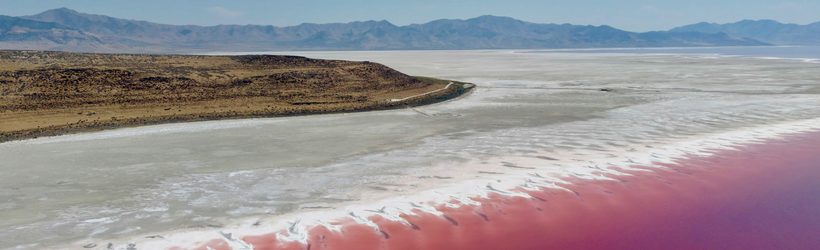
Utah doesn’t have to guess what happens when terminal saline lakes dry up—we can look at cautionary tales around the world. California’s Owens Lake dried up by 1926 after its water was diverted to Los Angeles. Today, it’s one of the single largest sources of PM10 particulate matter pollution in the United States, presenting major health concerns for 40,000 people in Owens Valley. Los Angeles County has spent over $2.5 billion trying to combat dust storms from the dried lakebed.
Dr. Henley warns of the parallel to our situation: “If Great Salt Lake dries up, the cities along the Wasatch Front will cease to exist and be replaced by urban graveyards and wastelands.” The Aral Sea in Central Asia and Lake Urmia in Iran tell similar stories of environmental catastrophe triggering social and economic collapse.
Population, Sustainability, and Our Shared Future
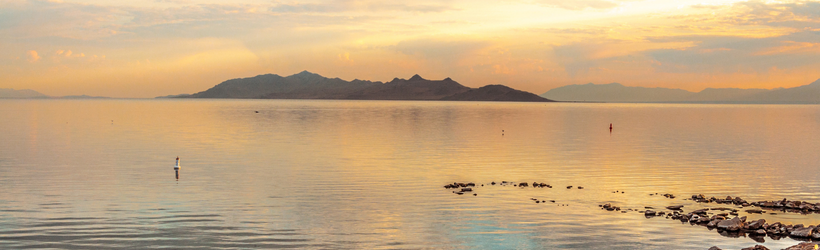
The relationship between Great Salt Lake and a sustainable population in Utah is direct and undeniable. A healthy lake means:
- Breathable air for the 2.5 million people along the Wasatch Front
- Economic stability through sustained industries and tourism
- Water security through lake-effect precipitation and preserved snowpack
- Livable communities that can attract and retain talented workers
- Environmental justice that protects our most vulnerable populations
Conversely, a dying lake means toxic dust storms, billions in economic losses, public health crises, water insecurity, and communities that become increasingly unlivable. Young professionals are already expressing concerns about relocating to Utah due to environmental and health risks. Tech companies struggle to recruit talent. Property values face decline. The ability to sustain our current population becomes increasingly questionable.
The Path Forward
The good news is that we’re not powerless. Great Salt Lake can recover if we act decisively. Record snowpack in 2022-23 temporarily raised water levels by 5 feet, demonstrating that the lake can respond to increased water flow. But temporary reprieves aren’t enough—we need sustained action.
This means:
- Water conservation at every level—agricultural, industrial, and residential
- Policy changes that prioritize water flow to the lake
- Continued monitoring of air quality and dust exposure
- Support for affected communities, especially those facing disproportionate impacts
- Public education about the lake’s vital role in community health
The science is clear: preserving Great Salt Lake isn’t about choosing between people and nature. It’s about recognizing that human communities and the natural environment are inseparably linked. A healthy lake means healthy people, sustainable economies, and thriving communities.
Conclusion
The Board of the Utah Population & Environment Council understands the connection between population sustainability and environmental health. Great Salt Lake is the perfect illustration of this truth. We cannot sustain a healthy population on the Wasatch Front without a healthy lake.
The question before us isn’t whether we can afford to save Great Salt Lake—it’s whether we can afford not to. Every dust storm reminds us that the clock is ticking. Every scientific study reinforces the same conclusion: the health of our lake and the health of our communities are one and the same.
The Great Salt Lake has sustained life in Utah for millennia. Now it’s our turn to sustain the lake—because in doing so, we sustain ourselves, our children, and the future of all who call Utah home.
The Utah Population & Environment Council (UPEC) advocates for sustainable communities through the preservation of our environment. Learn more at utahpopulation.org
Sources:
- Sierra Club, “Why the Shrinking Great Salt Lake Is a Public Health Crisis”
- U.S. Geological Survey, “Dust from the Great Salt Lake dry lakebed: a possible health risk”
- Grineski et al., “Harmful dust from drying lakes,” One Earth, 2024
- University of Utah research on economic impacts of Great Salt Lake dust
- Utah Division of Water Resources, Great Salt Lake Information
- Think Global Health, “Shrinking Shores, Rising Risks in the Great Salt Lake”
Images in this post were created using Canva.