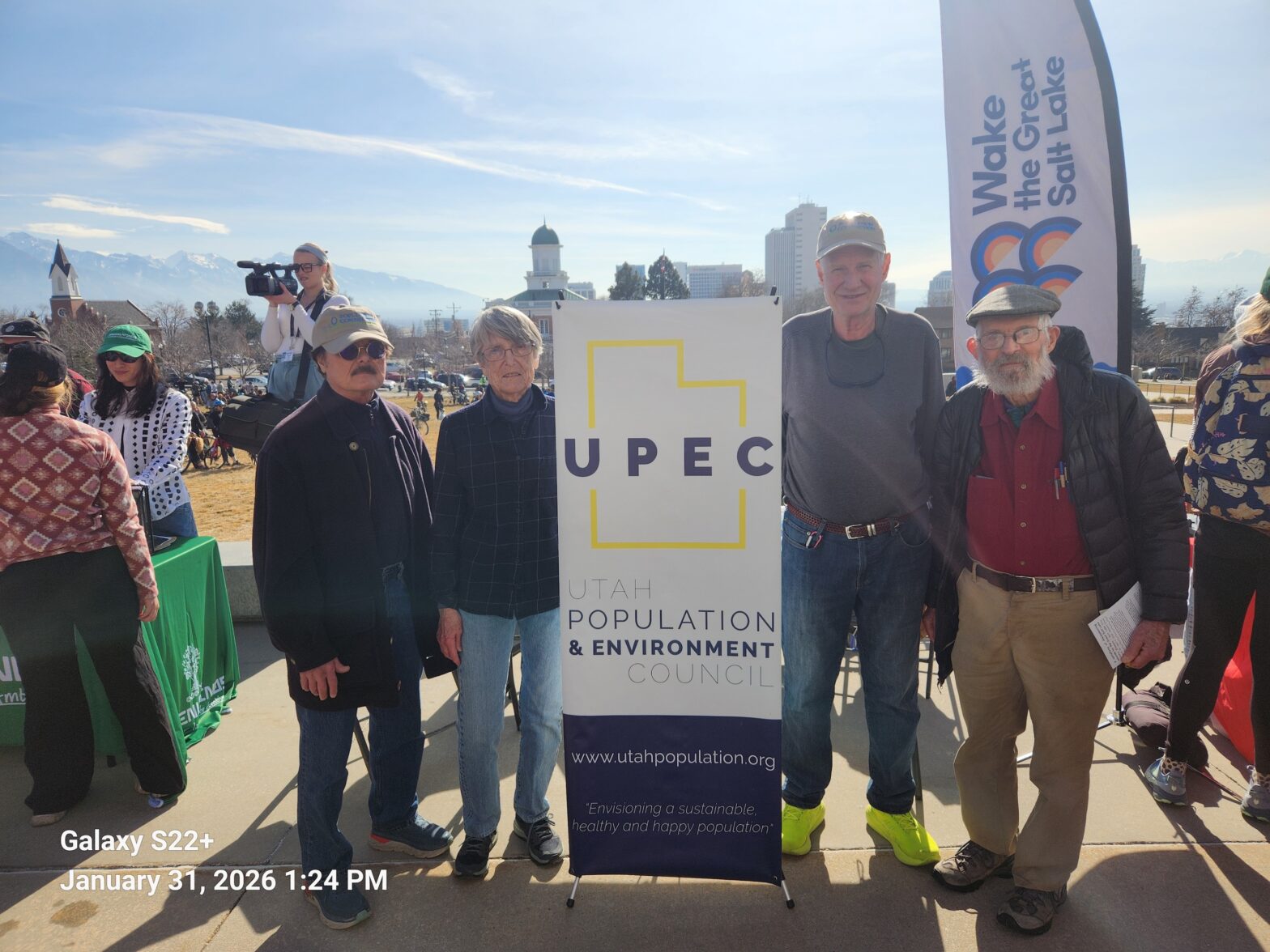
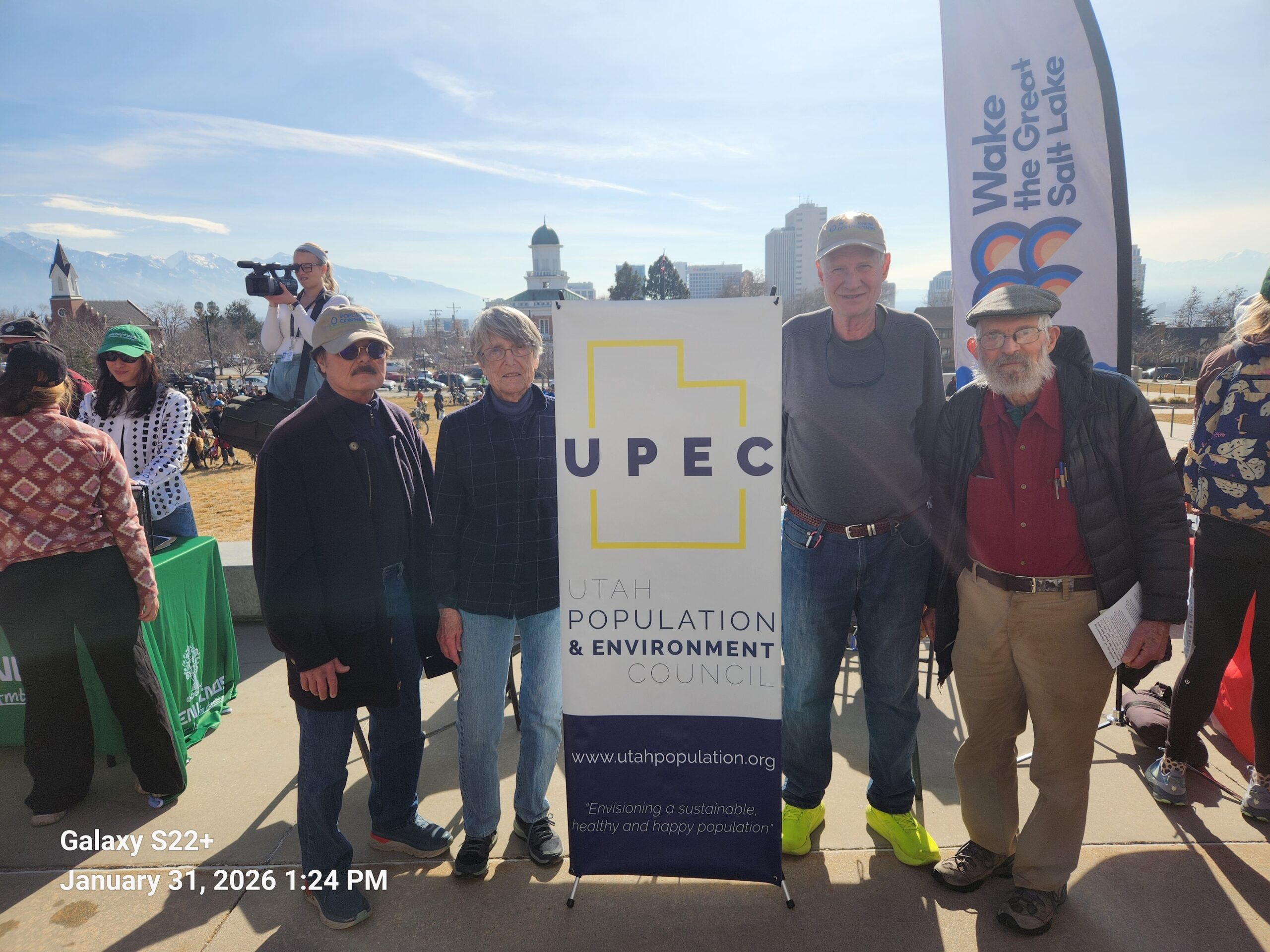
We were proud to join the Save Great Salt Lake rally again this January — and we’ll keep showing up for this cause.
At the Utah Population & Environment Council (UPEC), protecting our environment and preserving our Earth isn’t just a priority — it’s core to who we are. Great Salt Lake is a vital part of Utah’s ecosystem, economy, and identity. Its continued shrinking is not just an environmental concern; it’s an existential one for Salt Lake City and the surrounding communities.
We made our voices heard alongside our board members (left to right): Gary Hanneman, Ann O’Connell, Gray Griffin, and Doug Stark — thank you for being there.
And to everyone who stopped by our table for a conversation: thank you. These exchanges remind us why this work matters. The more we learn, the clearer it becomes — population and environment are deeply interconnected. We cannot protect one without caring for the other.
Stay tuned for a follow-up blog entry showing the direct relationship between saving Great Salt Lake and having a healthy and sustainable population in the Salt Lake Valley and the great state of Utah.
A few years ago, I was introduced to a term from quantum physicist, David Bohm, called the “holomovement.” He coined the word to describe a dynamic and unbroken totality that underlies all of reality.
I often think of that unbroken reality at the quantum level when I see it at play in the waves of our social fabric. Quotes like these below also illustrate our interconnectedness:
“Humankind has not woven the web of life. We are but one thread within it. Whatever we do to the web, we do to ourselves.” ―Chief Seattle
“Whatever affects one directly, affects all indirectly.” ―Dr. Rev. Martin Luther King, Jr.
“To harm nature is to harm yourself. To care for it is to care not just for yourself, but for the entire universe.” ―Michael Bassey Johnson
“You see, in this magical tapestry, threads of myself are intrinsically woven within the seams of all else. I cannot help but marvel at the complexity of these interconnections.” ―Lavinia Busch
“Every piece of you holds the whole—not as poetry, but as fact.” ―David Maze
These quotes show the intrinsic understanding of quantum physics: everything is connected to everything else. There is no such thing as separation. Literally, our lives depend on how well we treat this glorious Earth and each other.
It is with this deep interconnectedness in mind that we ask for your financial support of UPEC – the only organization in Utah working at the intersection of population and our environment.
As 2025 draws to a close, please make a donation, of any size, to support the work of UPEC. All gifts matter. All contributions make a difference. Donate online here!
Your financial support helps us maintain our website. In the last 90 days, 1400 people visited UPEC’s website. This demonstrates that the website’s content of research and blogs are meaningful to people in Utah and beyond. And in 2026, your donation will help us host a Speakers Series that will be focused on the dynamic relationship between population and the environment.
Now and in the coming year, please hold tight to each other. Be generous with your love and affection. Find ways to take better care of the Earth. And express gratitude daily for the spectacular planet that carries us through the Milky Way at 500,000 mph.
With love and appreciation for my quantum connection to each of you,
Susan Soleil UPEC Board Chair
To donate by Check:
Mail to: Gray Griffin 2591 Green Oaks Dr Bountiful, UT 840102
In the US, this week is a set aside for giving thanks. And the Board of Utah Population & Environment Council (UPEC) has lots to be grateful for in 2025.
Thanks to Xmission for hosting our website! This free service from Xmission is a gift to Utah in general and to nonprofits specifically. Thanks for being a generous host.
Thanks to Felipe Zurita for creating our new website! Please check it out HERE. And share the link with others who care about our human population living in harmony with all of nature.
Thanks to the long-standing UPEC Board Members who have cared about and carried UPEC for years and years! Gratitude for your dedication and tenacity.
Thanks to the Quaker Earthcare Witness group in Laguna Beach, CA. They selected UPEC to receive a $500 donation this past summer. Thanks for the contribution and for supporting other causes you care about.
Please consider donating to UPEC as 2025 closes out. UPEC is the only nonprofit in Utah researching and highlighting how population affects all other parts of our environment. Financial gifts of any size make a difference. Below are two ways to donate. Thank you!
Last, please talk about the impact of our human population on other species over the holidays with friends and family. We need more voices in private homes, public spaces, and on social media talking about how uncontrolled growth of all kinds is negatively impacting our beautiful planet.
UPEC Board Members send you wishes for a transformative New Year! May we find viable and scalable solutions for our poly-crises.
In peace and with love,
Susan Soleil Board Chair
To donate by Check:
Mail to: Gray Griffin 2591 Green Oaks Dr Bountiful, UT 840102
Solutions Through Reproductive Health — Why Health and Education Matter to Climate Change With Hannah Evans, Senior Analyst at Population Connection Date: Monday, October 27 Time: 7:00–8:00 PM MDT Location:Online via Zoom. Register Here.
Join the Utah Population & Environment Council for an inspiring and solution-oriented conversation with Hannah Evans from Population Connection, the largest grassroots population organization in the United States!
About the Presentation
In Solutions Through Reproductive Health, Hannah will explore how improving access to healthcare, education, and women’s empowerment are key to addressing climate change and global sustainability challenges. By examining the root causes of high fertility and the interconnections between poverty, resource use, and environmental pressures, Hannah offers a holistic perspective on how population dynamics shape the future of both people and planet.
Hannah Evans is a Senior Analyst at Population Connection, where she focuses on the intersections of population, health, human rights, and climate change. Her work investigates how population dynamics interact with global social, political, and environmental systems, emphasizing integrated solutions that promote equity and sustainability.
She develops open-source educational resources, collaborates with international NGOs, and gives comprehensive presentations on the connections between population growth, women’s empowerment, and climate adaptation.
Before joining Population Connection, Hannah taught Women’s Studies courses on gender, science, and feminist theory and worked in sustainable agriculture and public health programs across Latin America. She holds a BA in Environmental Policy and Political Science and a Master’s in Political Ecology from San Diego State University.
About Population Connection
Founded in 1968 (formerly Zero Population Growth), Population Connection is the nation’s leading grassroots population organization, working at the intersection of demography, health, human rights, and sustainable development. With over 40,000 members and hundreds of thousands of supporters, Population Connection advocates for a sustainable future through education, advocacy, and action. Learn more: populationconnection.org/about-us
Register to Attend
Don’t miss this opportunity to learn how improving health and education worldwide can create lasting solutions to climate change.
Worldwide, coupling and fertility rates are declining. The Utah Population and Environment Council generally applauds the developments regarding decreased fertility rates. Especially since the world population is projected to climb from over the current eight billion to about ten billion by 2060.
One person who has done valuable research on coupling and fertility rates is Alice Evans, Demographer and Senior Lecturer at Kings College, London. A good summary of her work can be found in her Jan. 13, 2025 Substack Article: The Global Collapse of Coupling & Fertility.
This article is densely packed with relevant information, including changes in coupling and fertility rates across various countries as well as showing important divergences among countries. Just one example from the article, “From the 1960s, US fertility fell primarily due to fewer births among couples. In that context, baby bonuses might raise fertility. But today, the major contributing factor is the decline of coupling.”
One of the most intriguing considerations regarding decreases in coupling rates is her assertion that “The ‘relationship recession’ coincides with the rise in smart phones.”
What if smart phones are one of the major contributors to decreasing coupling relations and fertility rates? Use of smart phones is increasing dramatically. If there is a strong correlation between smart phone use and decreased relationships, how could you decrease the smart phone use on a to increase relationships? Also worthy of consideration – in countries where cell phone use is low for women, would fertility rates decline if women in those countries had greater usage of cell phones?
Take some time to consider the Substack article by Alice Evans. It provides valued information and raises major questions about coupling and fertility rates.
In his Nobel Prize acceptance speech, Norman Borlaug, the agronomist who developed a more productive and sturdier wheat warned us that he had only given us a pause in the ongoing race between incessant human population growth and our capacity to produce more food. Recently, more than a hundred Nobel Prize laureates signed a similar warning: “we are not on track to meet future food needs, not even close.”
In her essay in the June 20, 2025, New Yorker, Elizabeth Kolbert comments on Borlaug’s work and his warning and reviews two new books on this theme.
In his book on “We Are Eating the Earth: The Race to Fix Our Food System and Save Our Climate” (Simon and Schuster), journalist Michael Grunwald investigates agricultural practices and technical processes that are intended to produce food without negative side effects. He finds that these projects fail to produce more food and often lead to greater environmental damage. For example, it takes a lot of light bulbs to replace the sun.
Vaclav Smil, in “How to Feed the World: The History and Future of Food” (Viking), works with statistics. For example, he reports on the impossible technical capacities that would be required to grow even one percent of the world’s current meat consumption and repeats the warning about trying to duplicate photosynthesis. Although the photosynthesis upon which our food supplies depends may be inefficient , it is so complex and fragile a system it is unlikely to be duplicated by humans.
Smil does point out that the world (and particularly the people of the United States) waste a huge amount of food. Not enough to save mankind but surely something to be ashamed of.
Most, if not all, of the earth’s environmental problems are a result of human activity.
Some scholars have represented the problem with the formula I = P+A+T. I = Impact (on environmental) P = Population (size) A = Affluence (wealth) T = Technology
The validity of expressing environmental impact as a sum of independent factors has been the subject of debate among environmentalists. I = PAT is not, after all, a mathematical equation. It is only a graphic representation of the problem. One criticism draws attention to the difficulty of expressing the inter-relationships among the three factors, another suggests that there are other important factors not included in the formula, such as political and social structures.
The Dependent Variable: Impact
The variable “I” in the “I=PAT” equation represents environmental impact. The environment may be viewed as a self-regenerating system that can endure a certain level of impact. The maximum endurable impact is called the carrying capacity. As long as “I” is less than the carrying capacity the associated population, affluence, and technology that make up “I” can be perpetually endured. If “I” exceeds the carrying capacity, then the system is said to be in overshoot. Overshoot may degrade the ability of the environment to endure impact, therefore reducing the carrying capacity.
Simply put, each I=PAT factor affects environmental quality as a result of the combination of each factor’s effect on the carrying capacity (the ability of a particular region or biome to support a particular population with basic survival resources/needs as well as the ability to sustainably absorb the resulting waste and pollution). A stable carrying capacity results in a sustainable and healthy quality of life for all resident species.
Population (size)
The larger the population (global humans currently at 8 billion+), the more stress and negative impact it has on the carrying capacities of both the occupied and fringe environments. This resulting decrease in the local carrying capacity results in population overcrowding, over resource consumption and pollution with its resulting negative effects on the environment and decreased quality of life for all.
Environmental impacts of population
Increased population increases humans’ environmental impact in many ways, which include but are not limited to:
• Increased Land Use – Results in habitat loss for other species
• Increased Resources Use – Results in habitat loss of other species
• Increased Pollution – Can cause sickness and damages ecosystems
• Increased climate change
• Increased biodiversity loss
Affluence (wealth)
The variable A in the I=PAT equation stands for affluence. It represents the average consumption of each person in the population. As the consumption of each person increases, the total environmental impact increases as well. High resource consumption with high resulting waste and pollution is not sustainable, healthy or otherwise conducive to a reasonable quality of life for all.
Technology (resource intensity)
The T variable in the I=PAT equation represents how resource intensive the production of affluence is; how much environmental impact is involved in creating, transporting and disposing of the goods, services and amenities used. Improvements in efficiency can reduce resource intensiveness which reduces the T multiplier.
However, increases in efficiency from technologies such as renewable energy can reduce specific environmental impacts, but due to increasing prosperity these technologies yield for the people and businesses that adopt them, technologies actually end up generating greater overall growth into the resources that sustain us.
Impact (of combined factors)
In summary, each factor increase within I=PAT combines and compounds to increase the negative impacts on the carrying capacity of the earth’s environment. Sadly, each of these factors continues to increase with the predominant societal, economic and political attitude of pro-growth at all costs, including the continued infinite consumption of the finite natural world.
Edward Abbey, environmental author and activist said: “Growth for the sake of growth is the ideology of the cancer cell”.
SUGGESTED SOLUTIONS TO REDUCE IMPACT (I)
Population (size)
• Lower fertility rates / smaller families • Women’s empowerment and girls’ education • Access to family planning and contraception for all Note: more of the above results in less need for abortions.
Affluence (wealth)
• Sustainable spending on basic needs and less on luxury materialism • More activities, leisure and cultural
Technology/Economics
• Less consumption with less energy requirements (renewable and non-renewable) • Economic steady state sustainability. Refer to the Center for A Steady State Economy (CASSE) steadystate.org
Attitudes/Culture:
• A cultural and spiritual paradigm shift in environmental and economic attitudes • Respect for the earth, each other and all sentient beings • Economic de-growth • Environmental pro-growth • Balance
In Summary the I=PAT equation can be a useful way of thinking about and then addressing the global, national and local environmental concerns.