Creating Change

First Drum Roll…

UPEC has an updated website. YAY! A big thanks and shout-out to XMission for hosting our website for free. Please check out the refreshed site and the beautiful images of Utah that grace the home page HERE. If you have comments on the site, please share with us: info@utahpopulation.org

Second Drum Roll…

The Board of UPEC recently decided to revive our Small Families Campaign for the next few years. We want to be a logical and compassionate counterweight to “the sky is falling” alarms about a declining birthrate. We will keep you updated here as this
campaign takes shape.

Creating Change

I have been thinking a lot about power over vs. power with, really listening to each other, and what I might do to have a positive impact in these turbulent times. Below are some of the musings that have been tumbling around in my head.

  • Power with: None of us like being told what to do. From toddlers to our great
    grandparents, we all like options, having autonomy, and making our own
    decisions. That is how lasing change is made.
  • Deep Listening: When we actively listen to the person in front of us, for what they
    really care about, we often find we have much in common. We can get more
    done when starting from a place of shared values. And truly listening is key.
  • How might I have more impact: Keep it local is my newest mantra. I cannot
    change tariff wars or federal policies. But I can work with local groups to create
    change in my neighborhood and community.

I share all of this because it relates to the choices we make regarding having children or not; and if so, how many? How might we really listen to those who make different family choices? Do young people feel like they even have options and autonomy right now? Am I doing enough in my community to support others? Where might I do more?

Solutions in tidy packages with shiny bows do not exit. Collaboration is messy. Deeply listening is challenging. Engaging in my local community takes time, effort, and energy.

My wish is that all of us, you and me, find more ways to be challenged and engaged in
causes that make lasting change!

In peace,

Susan

Biodiversity and Human Population

Stephanie Feldstein, Population and Sustainability Director, Center for Biological Diversity provided a well-informed presentation on “Biodiversity and Human Population” as part of the Utah Population and Environment Council, 2024 Speakers Series on May 6, 2024.

Stephanie leads the Center’s work to highlight and address threats to endangered species and wild places from runaway human population growth and overconsumption. Previously Stephanie worked for Change.org, where she helped hundreds of people start and win online campaigns to protect wildlife. She holds a bachelor’s degree from the University of Michigan. She is the author of The Animal Lover’s Guide to Changing the World (St. Martin’s Griffin, 2018).

Stephanie described the increase in human population over time. She also portrayed the growth in consumption. These are the “hockey sticks” that show such dramatic escalations in population and consumption over the last 1,000 years or so.

Stephanie talked about the impacts of increased human population and consumption on wildlife populations. Two examples provided were the decrease in bumble bees due in part to the increase in honeybees, which can be considered livestock. Another example is the estimated 10,000 grizzly bears that were in California, while now there are none.

Bringing this closer to Utah, 12 of the 15 fastest growing cities in the United States are in the west. And 40 million people now live in the Colorado River Basin.

The human population is expected to grow in the Salt Lake area and there is a projection of over 6 million people that could be living in Utah in the future. About three-quarters of Utahns live in the Great Salt Lake watershed, which has numerous concerns including increased agriculture and toxic chemicals. These increased concerns have helped result in petitioning the United States Fish and Wildlife Service (USFWS) to list the Wilson’s Phalarope as an Endangered species.

Some ways to address this population concern are to help support reproductive freedom. Still an estimated nearly half of the population comes from unplanned pregnancies. Also, more could be done to help educate people about the impacts of increasing population, including impacts on wildlife.

Stephanie asked that people sign the petition to protect the Wilson’s Phalarope under the Endangered Species Act. You can sign on to this petition at: Back Our Petition for Wilson’s Phalaropes (biologicaldiversity.org)

Click Here to view the recording of Stephanie’s presentation from May 6th.

Passcode: B&2x&NEM

Lessons From the Fight to Save Great Salt Lake

Three-quarters of Utah’s population lives around Great Salt Lake, one of the fastest-growing areas of the
country. It’s also an oasis for more than 10 million migratory birds passing through every year.


Although Utah is one of the least densely populated states in the U.S., more than 2 million people are
crowded along the Wasatch Front. The Great Salt Lake provides a stark example of the impact of human
population pressure and how protecting imperiled species can protect our future, too.

Continue reading “Lessons From the Fight to Save Great Salt Lake”

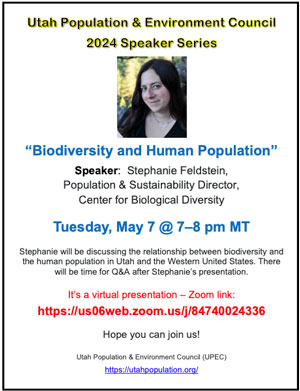
Biodiversity & Human Population – Speaker Series – May 7

Tuesday, May 7 @ 7–8 pm MT

Stephanie will be discussing the relationship between biodiversity and the human population in Utah and the Western United States. There will be time for Q&A after Stephanie’s presentation.

Speaker

Stephanie Feldstein
Population & Sustainability Director
Center for Biological Diversity

Virtual Presentation

Zoom Link: https://us06web.zoom.us/j/84740024336

Please RSVP on via our Facebook Event: https://fb.me/e/1ku6BCn3c

Printable Flyer

The world faces many energy-related challenges – pt. 3

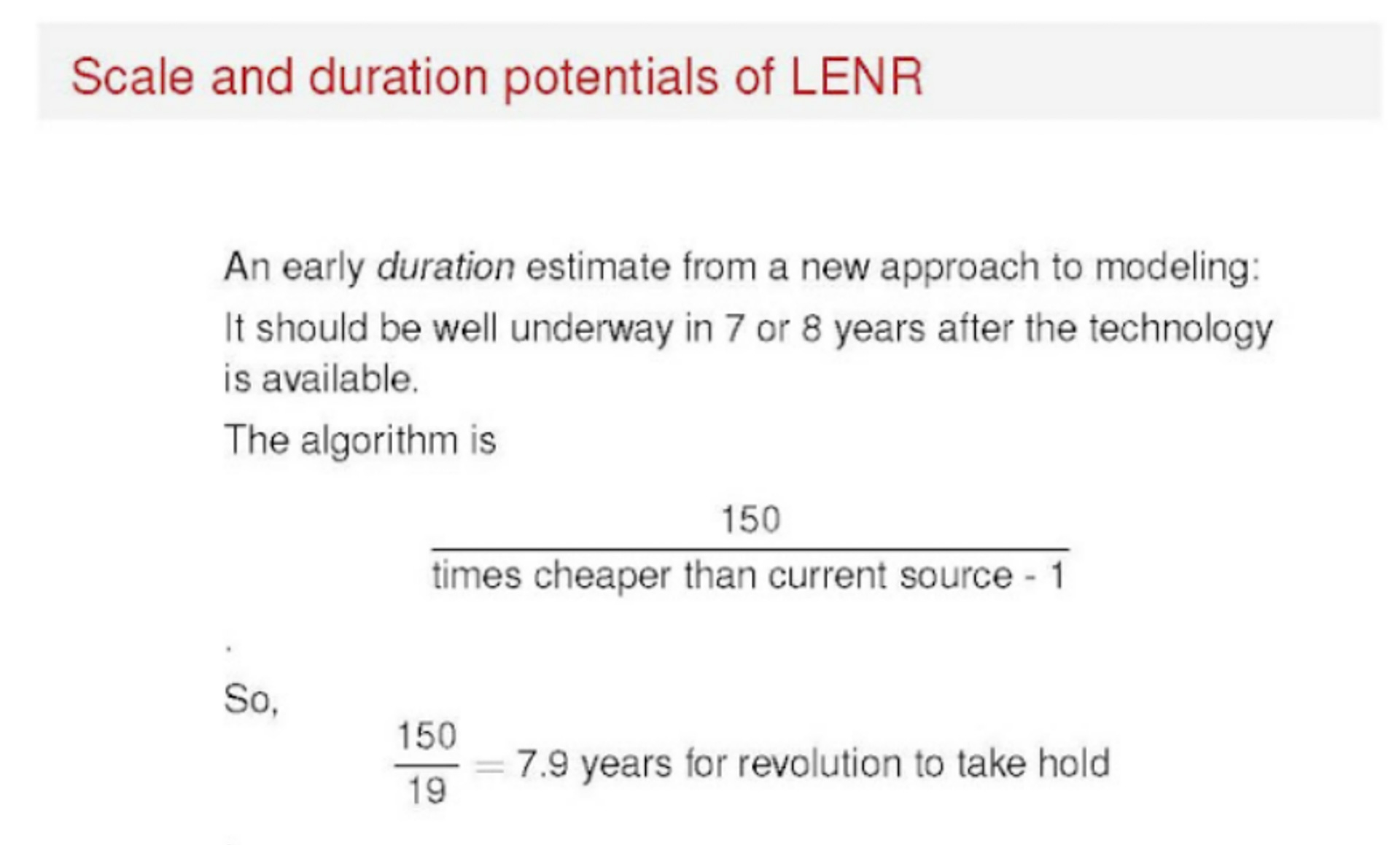
PART 3: The next important question is how long this transition will take once CMNS energy is available. Once again, to the blackboard.

Using historical price and duration data from the EIR discussed above to define our duration algorithm, we can estimate the duration of the CMNS energy revolution using the much greater (starting at 20X) price differentials that will be available. The surprising answer is that we can estimate this revolution, infrastructure changes and all, can happen in eight years. And this is motivated by basic economic substitution, and is, therefore, much easier and straightforward than attempting to do so by jawboning, legislation, regulations, taxes, or subsidies in any combination.

Having answered the “scale” and “duration” questions using our estimates, the crucial question becomes how to actually accomplish this next great energy revolution.

The work of Fleischmann and Pons, two electrochemists who in the 1980s conducted the foundational research into a new energy source, needs to be recalled from obscurity and seriously examined. This work, originally labeled “Cold Fusion,” is now called more descriptively Low Energy Nuclear Reactions (LENR), Chemically-assisted Nuclear Reactions (CANR), Condensed Matter Nuclear Science (CMNS), and more recently, Solid-State Atomic & Fusion Energy (S-SAFE). These names all refer to what is likely to be an underlying new physical process that is different than any other proposed solution. And this reaction offers the potential to produce both cheap and clean energy that is not offered elsewhere by any known technology.

Scientists have been seriously pursuing this new science since 1989, the year of the original Fleischmann and Pons announcement; they are now able to replicate and scale this new science such that it can become commercially feasible. The common problem these scientists face is a lack of funding to complete their research; most funding for transformational research is for Hot Fusion for the past 70 years. Hot Fusion has not demonstrated any scientific success, and the prospects are questionable, while CMNS has. We should fund CMNS research to succeed.

Given the threats and the opportunities, we must find a way to fund research for CMNS substantially; doing so will lead to the next great revolution in energy sources and living standards and, along the way, halt global warming.

A word to potential investors. I think that energy generation will become so cheap that it will be difficult to earn major profits by simply producing the energy. But the economic potential that very cheap energy unleashes should be amazing! If you need proof, simply look at the last energy revolution. The price differential between wood and coal that caused the English Industrial Revolution was about 2.5 times. With our energy technologies, with investment, that will be 20 times cheaper and much greater. So, we can have 10 times the last Industrial Revolution’s worth of progress. That is a radically different world. Why are we waiting?